

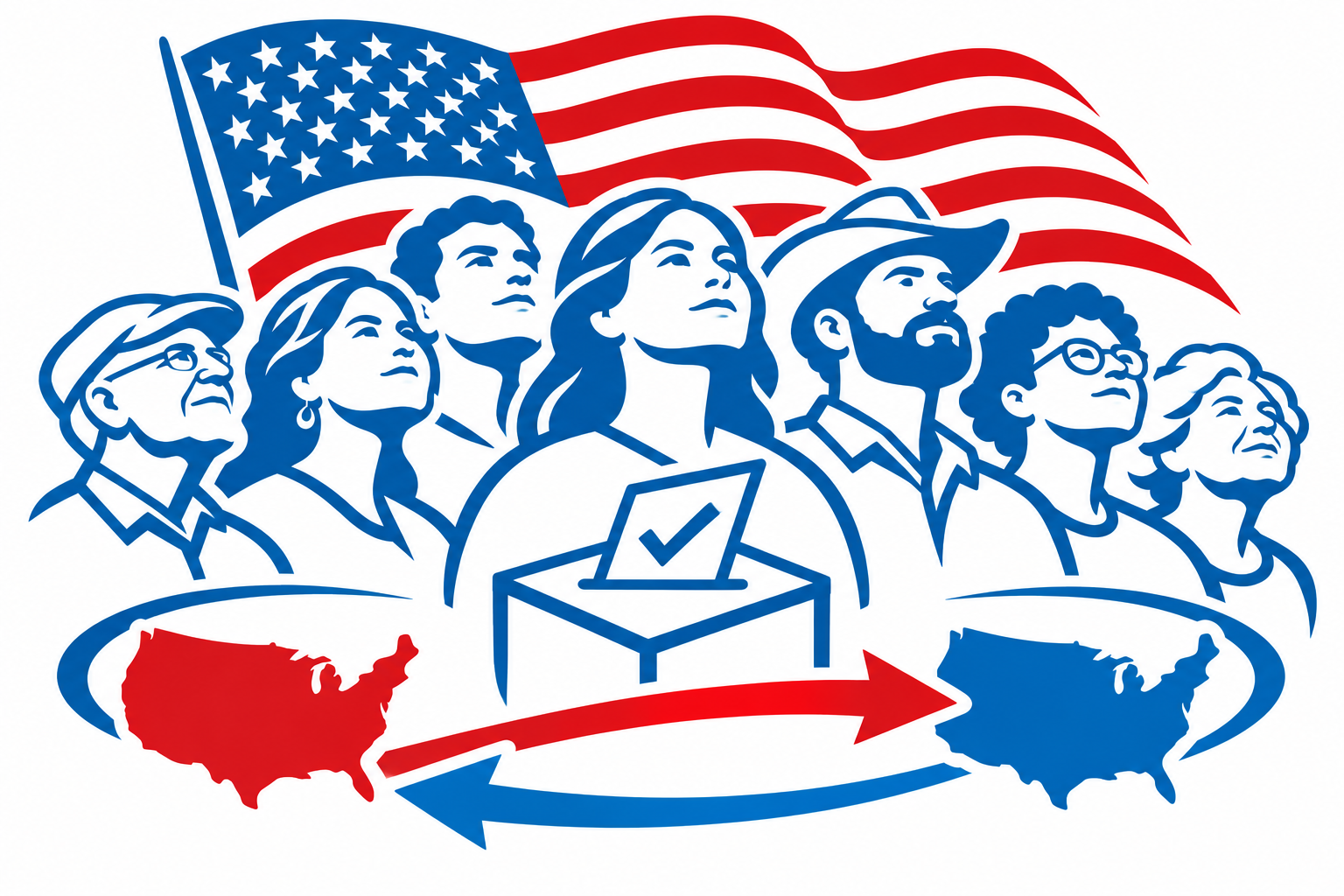
There are voters who vote. They're people. They aren't simply Democrats who vote for Democrats and Republicans who vote for Republicans. They're people who vote for many reasons — identity, loyalty, values, dissatisfaction, hopes for the future, and concerns about their lives today.
Some vote because they've always identified with a particular party. Some because they admire a candidate or distrust an opponent. Some vote by deeply held beliefs about what is right and wrong. Others are angry with the way things are and want something different.
And sometimes they’re conflicted — they’re loyal to a party but disagree with its candidate. A voter may want change but questions whether the “change candidate” represents their values.
That's worth thinking about. Because our political identity, our party loyalty, and our values aren't necessarily the same thing.
We've all heard the pundits call some states "Red States" and others "Blue States." If your state doesn't fit one of these labels, you must be in a "Swing State."
But today we look at the election results and wonder ... where did the Red States go? Some states “changed color.” How can this be?
I'm reminded of Illinois State Senator Barack Obama, speaking at the 2004 Democratic National Convention:
"The pundits like to slice-and-dice our country into Red States and Blue States; Red States for Republicans, Blue States for Democrats. But I've got news for them, too. We worship an awesome God in the Blue States, and we don't like federal agents poking around our libraries in the Red States. We coach Little League in the Blue States and have gay friends in the Red States. There are patriots who opposed the war in Iraq and patriots who supported it. We are one people, all of us pledging allegiance to the stars and stripes, all of us defending the United States of America."
It's easy to dismiss an entire state because of its historical voting record. But that dismisses the millions of individuals who live there, each with their own hopes, concerns, experiences, and expectations of government.
There aren't Red States and Blue States. There are Americans. Some vote Republican, some vote Democratic, and some change their minds from one election to the next. Some don't vote at all. But none of them should be written off because of where they live or how their neighbors voted.
And that's something Democrats should remember.
Our job isn't simply to win elections in places where Democrats have won before. It isn’t to persuade people that they're wrong about what matters to them. Our job is to demonstrate that the values we profess — freedom, justice, equality, opportunity, and democracy — matter in their lives, wherever they live.
The Democratic Creed gives us a standard for doing that. It proclaims what we believe, what we expect of government, and what people should expect of us. The Democratic Creed isn't a test of party loyalty. It's a statement of the values that give our political identity meaning.
And words alone aren't enough. People want to know what those beliefs mean for their families, their communities, and their futures. They want to see that our actions reflect our values, and that those actions produce results that improve their lives. And the Democratic Creed is a standard by which they can judge the actions of those who claim to represent them.
An election tells us how people voted on one particular day. It doesn't tell us who they are, what they believe about everything else, or how they'll vote tomorrow.
So perhaps the lesson of this election isn't that Red States are turning Blue. Perhaps it's that the colors were never a very good description of the people who live there.
We would do well to remember that.
There are no states to write off. There are people to listen to, people to understand, and people whose trust we must earn.
And that work doesn't begin or end on Election Day.
