

DECLARED, DEFENDED, AND LIVED
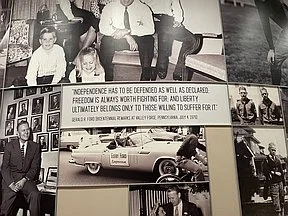
On the 200th anniversary of the Declaration of Independence, President Gerald Ford reflected on America’s founding with these words:
“Independence has to be defended as well as declared. Freedom is always worth fighting for and liberty ultimately belongs only to those willing to suffer for it.”
It is striking that Ford chose three different words: independence, freedom, and liberty. Today we often use those words interchangeably. But America’s history suggests they are related steps in an ongoing journey.
Independence is the beginning. In 1776, Americans declared themselves capable of governing themselves. They rejected rule by a distant king and claimed the right to shape their own future.
But independence alone guarantees nothing. A nation can be independent and still unjust. A people can govern themselves and still deny dignity to others. History has shown us that repeatedly.
Freedom is what people hope independence will make possible: the ability to speak honestly, worship freely, pursue opportunity, participate in public life, and live without fear of arbitrary power. Freedom is deeply personal. It is felt in daily life.
Yet freedom does not sustain itself. That is where liberty enters the story.
Liberty is not merely the absence of restraint. It is the shared civic commitment required to preserve freedom for everyone, not just for ourselves. Liberty requires citizens who are willing to accept responsibility for one another and for the institutions that protect our rights. It requires participation, sacrifice, and a belief that self-government is worth the effort.
That is why Ford's final line is so powerful:
“Liberty ultimately belongs only to those willing to suffer for it.”
The question naturally follows: What does that sacrifice look like in a modern democracy?
Most Americans will never fight on a battlefield to preserve the Republic. Instead, we are called to a different kind of service.
We are called to vote. To participate. To tell the truth. To hold leaders accountable. To defend the rights of people with whom we disagree. To work toward a society that is fairer, freer, and more just than the one we inherited.
This is where the Democratic Creed becomes relevant.
The Democratic Creed is not simply a statement of beliefs. It is a guide for the practice of democratic citizenship. It reminds us that liberty survives only when citizens act on the values that make self-government possible.
We affirm Equality because liberty cannot flourish when some people are treated as less deserving than others.
We affirm Democracy because liberty depends on the consent of the governed.
We affirm Freedom because every person deserves the space to think, speak, worship, and live according to their conscience.
We affirm Justice because liberty without fairness becomes privilege.
We affirm Opportunity because freedom means little if people are denied a genuine chance to improve their lives.
And we affirm the Duty of Government because a free people have a responsibility to work together through democratic institutions to secure these blessings for all.
Seen this way, the Democratic Creed is not separate from the American story. It is an expression of the same promise first announced in the Declaration of Independence. The Declaration tells us what human beings are entitled to.
The Democratic Creed reminds us what citizens must do to make those promises real. Every generation of Americans has faced that challenge.
The Revolution asked whether people would sacrifice comfort for self-government.
The Civil War asked whether liberty belonged to all people or only to some.
The Civil Rights Movement asked whether America would honor its promises of equality and citizenship.
Today, we face our own test. Will we choose participation over cynicism? Truth over misinformation? Democracy over division? Responsibility over indifference?
Ford's words remain relevant because they remind us that America is not sustained by documents alone.
The Declaration declared the promise.
Generations of Americans defended it.
Our responsibility is to live it.
That is the work of liberty.
And that is the work of the Democratic Creed.
Image from Gerald R. Ford Presidential Museum, Grand Rapids, Michigan. Photo by J. Rusch.