

OUR LIVES, OUR FORTUNES, AND OUR SCARED HONOR
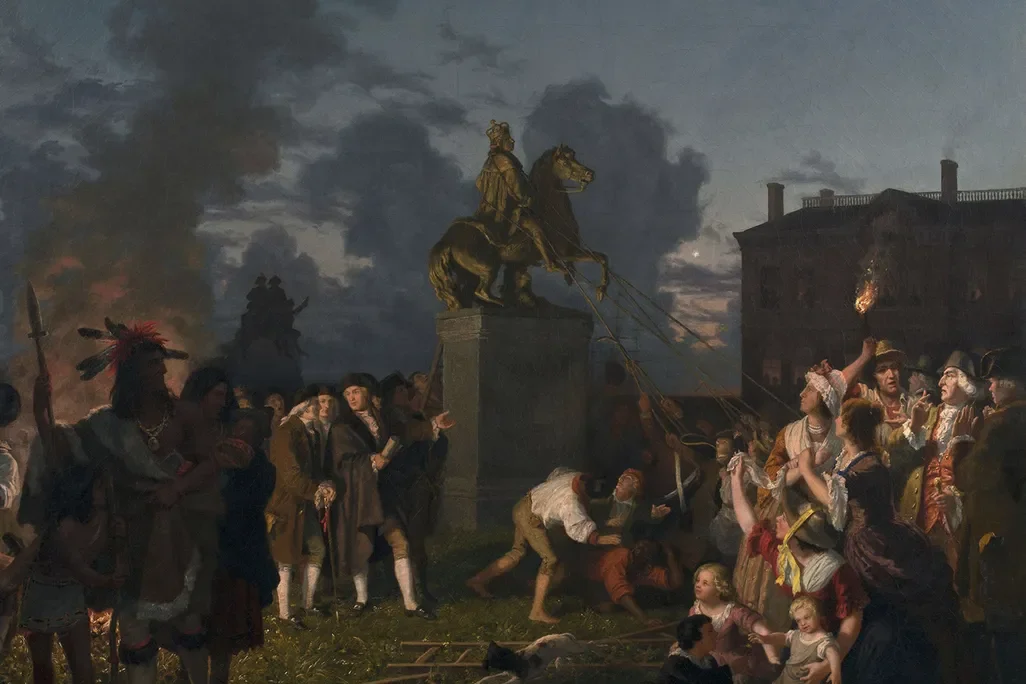
On July 9, 1776, the Declaration of Independence was read aloud to the Continental troops mustered at the Commons, an open field one mile uptown from Bowling Green. The document named 26 charges against the British monarch, citing abuses of his American subjects. Washington hoped the Declaration would encourage “every officer, and soldier, to act with Fidelity and Courage.” Some took the suggestion literally: As one officer noted, the troops “long had an inclination” to attack the king’s likeness.
Within hours, a crowd armed with axes, hammers and ladders had assembled in Bowling Green and pulled down the monument. Eyewitnesses reported a carnal scene of material violence. Someone beheaded the statue; others drew its parts through the streets. Army lieutenant Isaac Bangs watched a man pounce on the gilded figure of the king, scratching gold leaf from the statue’s surface. A Philadelphia newspaper relished the thought of the statue “laid prostrate in the dirt … the just des[s]ert of an ungrateful tyrant,” noting that the statue’s destruction followed the reading of the Declaration of Independence.
— Smithsonian Magazine, https://www.smithsonianmag.com/history/a-toppled-statue-of-george-iii-epitomizes-the-ongoing-debate-over-americas-monuments-180979463/
We all know that the Declaration of Independence was approved on July 4, 1776. That marked the birth of the United States of America. But there was no internet - no Facebook or Twitter or TikTok - in 1776. No C-Span, CNN, MSNOW, or Fox News. So the people didn’t know that this had happened - or that they were living in a new nation - until days, weeks, even months later.
So it was that four days later, on July 8, 1776, the Declaration of Independence was read aloud to the public by John Nixon in Philadelphia. The reading “was received with general applause and heart-felt satisfaction“. John Adams wrote that “The Battallions paraded on the common, and gave Us the Feu de Joy, notwithstanding the Scarcity of powder. The Bells rung all Day, and almost all night. Even the Chimers, Chimed away.“[1]
The following day, General George Washington ordered that the Declaration of Independence should be read aloud to his troops and the public in New York City. After hearing the words of independence, the crowd celebrated, then marched nearly a mile to Bowling Green, where they tore down the statue of George III. They beheaded the statue and hacked it into pieces [2].
It is now 250 years later. We are still dedicated to the Declaration of Independence. We built our Democratic Creed to reflect its spirit, its truths, and its beliefs. The Democratic Creed is the Declaration of Independence in 21st-century words.
We can honor our origins by recreating the excitement of 250 years ago. We can hold public readings of the Declaration of Independence on July 8, 2026 - exactly 250 years after that first reading in Philadelphia.
The words move me still. Read them alone, in a group, in public. Hear the words - without commentary, without interpretation, without drama. Hear them as colonists heard them in 1776 - as British subjects casting off their monarchy and facing an unknown future - facing it with hope, with determination, with resolve. Without knowing what lay ahead for them or their families. But willing to try.
We, too, can try, if, like those people of 1776, we are willing to “mutually pledge to each other our Lives, our Fortunes, and our sacred Honor.”
[1] Cited by Emily Sneff in the Declaration Resources Project, Harvard University, at https://declaration.fas.harvard.edu/blog/july-proclamations
[2] The crowd chopped off the head of the statue, hoping to mount the King’s head on a stake. But a British officer was able to steal it and sent the mutilated head to England. A portion of the rest of the statue was melted down and formed into 42,000 lead muskets for the Continental troops.
Image: Johannes Adam Simon Oertel's 1852–53 depiction of the George III's statue toppling features several ahistorical elements, including the presence of Alexander Hamilton and a fictionalized Native American family. New-York Historical Society. Retrieved from Smithsonian Magazine, https://www.smithsonianmag.com/history/a-toppled-statue-of-george-iii-epitomizes-the-ongoing-debate-over-americas-monuments-180979463/
